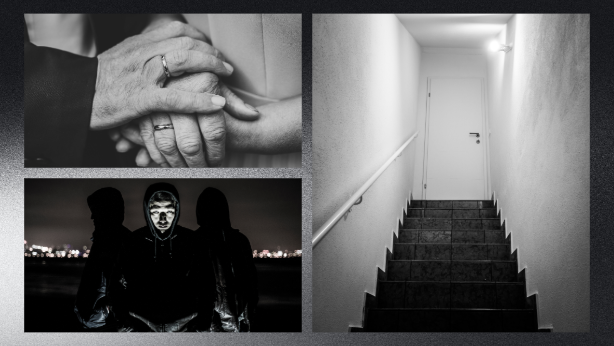
It’s the first Tuesday of September, so here I am at your doorstep with this month’s supplies—mostly food and books, as usual.
When you open the door, it’s like I’m looking at an old photo, you and the hallway tinged a sentimental amber by the redshift of the decades between us.
“Thanks for bringing all this stuff,” you say, voice muffled by all those years. “Do you want to come in? I just got some lasagna out of the oven.”
The invitation surprises me. You haven’t asked me in since you cocooned yourself in what you call “the good old days.”
“Sure,” I answer, pretty hungry after all the shopping.
Then everything is swirling the moment after I’ve stepped through the doorway. You steady me with a hand under my elbow.
“I forgot that translocation can be a little jarring,” you say. “It shouldn’t last long.”
Thankfully, you’re right. The wooziness passes quickly, and in no time, we’re bringing bags of groceries into the kitchen where the air is thick with tomato sauce and basil.
Outside the window above the sink it’s a sunny day, clear sky over the lively streets of the city in its heyday. The little lot of food carts is abustle with shift workers and college students getting cheap eats while kids play hopscotch and four square in the adjoining parklet.
“I still wish I could go out there without altering the timeline,” you say. “But just seeing it is plenty.”
“Isn’t it weird knowing things aren’t like this anymore?” I ask.
“No stranger than being absorbed in a movie. Even when you know the ending.”
Movies don’t go on indefinitely, I want to say. And no one eats all their meals in a movie theater.
But I just nod so we won’t end up in some heated rehashing about escapism.
“You look tired,” you say. “Why don’t you stay a while and rest? I can realign the passageway so when you leave it’ll be like you’ve only been here five minutes.”
“Thanks, but I don’t think staying in the past will help much. And I have other ways of taking a break.”
“Make sure you use them.”
“I will. I am.”
You hand me two plates, and I hold them by the lasagna sitting on the stovetop while you cut squares out of it with a spatula.
At the table in the alcove, we eat as though adhering to a vow of silence. You don’t have much to tell me, and you don’t want to hear any of the myriad things I could tell you about how much worse everything is now. Only faint music keeps complete silence at bay. The radio in the living room has been left on low, tuned to the kind of classic rock station our teachers would play during cleanup time. The music is so soft it barely gets my attention.
Until the familiar guitar chords of a folksy song stir the air. And they’re of course followed by the wistful lyrics about a memory fairy crystallizing past experiences into gems of personal history, fully accepting that her most beautiful work will be undone by a forgetting fairy. This musical tale was already old when we were growing up and is now doubly nostalgic, making me long for childhood and a seemingly simpler time before that.
Before I know it, tears are sliding down my face. You hand me a napkin, and I blot them away with it.
I half expect you to lighten the mood by saying something about this song being so popular because it’s such a tearjerker. But you say nothing, leaving space for the feelings welling up in me.
And now I have to say, “We’ve lost so much and will only lose more, and I have to face all that without you.”
“I know,” you say quietly. “But at least you’re facing it. I can’t manage that.”
“And you were always the reckless one.”
“It’s easy to be reckless in a safe world. That’s one reason I’m here. To hang on to whatever vigor is left in me. Or the illusion of it. Being confronted with our limits is hard. We just aren’t good at acknowledging how fragile it is to be human.”
It’s unlike you to be so forthcoming about your feelings, but that’s exactly the point you’re making, and instantly it’s clear that this is why I’m here—so we can reveal our truths to each other and let them find resonance in this space.
I take a deep breath and wait for you to go on. If you don’t, I will.
About the Author:
Soramimi Hanarejima is the author of the story collection Literary Devices For Coping. Soramimi’s recent work appears in Pulp Literature, Fjords Review and The Offing.