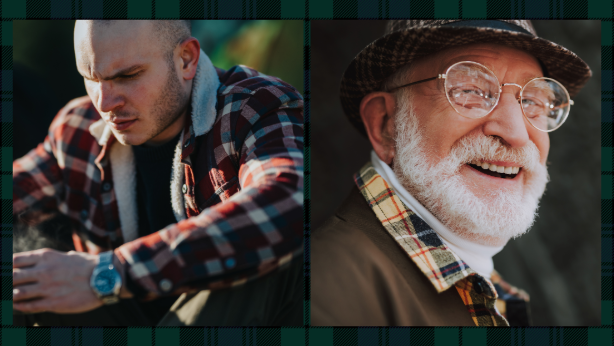
It wasn’t when I got the hang of cursing, exquisitely and generously, tutored by the bigger kids at the back of the school bus. It wasn’t when I puffed on my buddy’s mom’s unfiltered Kools in the woods – throat raw, lungs afire, coughing triumphantly. It wasn’t when I thumbed through Dad’s Playboy magazines and delighted at the sight of nipples peeking through an open plaid flannel shirt. It wasn’t when I thought I was the last one on the playground to know where a penis goes. (There was some confusion after a night in a tent in the backyard with two older boys.) It wasn’t so much when I first kissed Patty under the wild cherry tree or when I touched Penny’s soft, tiny breast somewhere beneath her shirt (also flannel) – trying desperately to distinguish between grope and caress. And oddly, it wasn’t when I pulled Mom off Dad – when she flew at him in one of many paranoid rages, screaming and ripping, shredding Dad’s shirt. Flannel, by the way.
It was when I learned how to split wood that I began to know something of becoming a man. Or at least clearly saw the outset of the endeavor. It was in those chilled November days, frost settling on the weeds behind the chicken coop, when, instinctively, it was time to hunker down for the winter – when I’d see a pile of coal dumped near the basement door of my grandparents’ farmhouse. But coal was only a backup for the wood that needed to be cut for the furnace. Cords of timber magically appeared. I don’t remember helping Grandpa fell the trees in the woods at the far edge of the pastures. God knows he needed the help, but he’d go out alone with his chain saw, this terrifying machine from the 1930s which looked like it used a Model T engine to power it. I could barely lift it, let alone wield it for its purpose.
The segments of wood with a larger girth needed splitting to fit through the furnace door, and they were relentlessly there like any chore on the farm, waiting to be tended to. The work nagged at me from just below my bedroom window where I was more interested in how oil paint spread on a canvas, discovering the differences between Ultramarine, Cerulean, Prussian, and Cobalt Blue.
It was then that I recognized in my limbs what it meant to be a man. It took a while to become unafraid of the sharp axe. I was warned about chopping my knee instead of a log, and the fear made me too cautious and ineffectual. It took even longer to master the undertaking – to split a piece in one stroke. It was frustrating, loosening the axe when it caught, hopelessly lodged in the wood. And then, angry, with a little more force, the log placed perfectly on the stump, and swinging the axe high over my head, I cleaved it cleanly, the two halves falling away. Soon, I found a rhythm, and the pile of split wood grew. With sweat running down my back, it was satisfying to remove my coat and swing in only a shirt – a flannel shirt. And it was perversely fulfilling when blisters erupted on my hands and every part of my body was sore the next day. I hoped for the eventuality of callouses.
But it wasn’t necessarily at that moment that I became a man. I think it may have been years later when comprehension set in. It was simple. The wood needed splitting, Grandpa needed my help with it, and I stepped up to do it.
About the Author:
David Sapp, writer and artist, is the recipient of Ohio Arts Council Individual Excellence Grants for poetry and art and is a Pushcart nominee. His poetry and prose appear widely in the United States, Canada, the United Kingdom, and Asia. His publications include articles in the Journal of Creative Behavior; several chapbooks; a novel, Flying Over Erie; a book of poems and drawings, Drawing Nirvana; and four books of poetry and prose, Love and History, Acquaintances, A Precious Transience, and a memoir titled The Origin of Affection, winner of the Violet Reed Haas Poetry Award.