The Orange Story: A Novella

Monday, August 2, 2010

CHAPTER FIVE

Demetri thinks it’s a good idea if we try out a counseling session where Dad and I each get ten minutes alone with him at the end. I wait in the hall outside his office while they’re in there talking. There’s no magazines or anything to look at, just a cheap, framed Van Gogh print hanging on the opposite wall—a self portrait of the man in a straw hat.

Dad stumbles out of the office looking like he needs a cigarette, and he’s not a smoker. I give him my seat and head into the office.

“Is there something the matter?” Demetri says. I’m staring over his head. His office is small. He keeps the window shades just cracked enough to let in the least amount of light.

“No,” I say. He’s got another cheap print over his filing cabinet—two ballerinas, one with her leg up on a pole, the other just watching. I don’t know the artist.

“When’s the last time you spoke to your mother, Derek?”

“Yesterday. After school.”

“You talk to her every day?”

“Most days.”

He nods. Demetri has a little goatee he’s always stroking. It drives me crazy. He says, “When was the last time you spoke with your father?”

“About sixty seconds ago.”

“I mean, when was the last time you had a conversation?”

I say, “I don’t know. A month, I guess.”

“A month is a very long time. You don’t talk at dinner?”

“Not really. He talks about stuff going on in politics. I don’t really listen, since I don’t care.”

“Why do you think that is?”

“Is this what you brought me in here for?”

Demetri doesn’t keep notes. He just sits in a seat across from mine with his legs crossed and his hands folded in his lap. “How about this?” he says. “Describe for me, in your own words, a typical day in the life of your dad. A work day.”

I say, “Well, he gets up. Grabs the paper, hits the john, hits the shower. Skips breakfast. He’s off to work by seven-thirty, back in time for dinner. He watches Jeopardy, watches a movie, watches the news, and hits the sack.”

“That’s it?”

“Pretty much.”

“Well, Derek, you’ve left an awful lot out.”

I spend a few seconds agreeing. “You’re right,” I say. “He stops at Blockbuster on his way home from work. He’s got a subscription I forgot to mention.”

“Derek, tell me what your father does for a living.”

“I don’t know,” I say.

“Sure you do.”

“He moves dirt.”

“He’s a contractor, Derek. There’s more to it than moving dirt. Your father has to run a whole business.”

“Okay,” I say. “He’s got some guys who work for him. They move dirt, too. And they smell like dirt. Dad likes his shower in the morning, so he goes to bed smelling awful most nights—this in spite of the fact that he’s pretty much a clean freak in every other way. Mom used to scream at him for it, but he didn’t care. He says he has to take his shower in the morning to wake up and taking two in one day would waste water. I don’t know the real reason why he does it that way. He’s just weird.”

Demetri uncrosses his legs. “Do you think he enjoys his work?”

“Nobody likes their job.”

“Sure they do.”

“Do you?”

He gives me a crooked look.

I say, “Did you always want to be a shrink?”

“I’m not a psychiatrist, Derek. I just help people talk through their problems.”

I nod. “You didn’t ever want to study art or anything?”

He says, “I wanted to be something I would be good at.”

“So you’re not good at art.”

“No,” he says. “I’m terrible.”

* * *

It’s a Saturday, and I should be sleeping, but I’m up rubbing my eyes in the kitchen at seven o’clock. Dad struts up to the coffee pot and pours himself a mug. “I think this is an excellent idea,” he says. “You know, I was skeptical at first, but that Demetri is an alright guy. I think he’s got the right idea.”

“Oh yeah?” I say. “Because I think he’s an idiot.”

“Get in the truck.”

On Demetri’s advice, I’m stuck spending the only Saturday left in September with my Dad on some kind of take-your-kid-to-work day that’s supposed to somehow make us understand each other better. Dad takes the suggestion like an excuse to torture me. “We’ll make a man out of you yet,” he says, grinning like he’s joking, but he’s only halfway joking. I think he’d love it if I actually enjoyed poking around in the mud.

Dad drives me all the way to Flint, forty minutes east on I-69, to stick me in a hole in the ground with a Dixie cup and a five-gallon bucket. “Cracked pipe,” he says. “Gottta keep the hole dry until the cement truck comes.”

He’s been coming to this jobsite for the past couple of weeks—an old strip mall they’re tearing down to make way for another strip mall. Dad and his men are laying the groundwork and putting in new pipes for sewer and water. “Just think of it like one of your video games,” he says. “Isn’t that Mario a plumber?”

Down the hole, it’s dark and cold. The dank comes off the walls nearly as heavy as it does up out of the leaking pipe. Up top, the sunlight shines through the opening. I crouch on my toes like that’ll keep the water from seeping through my sneakers, and I call up to my dad with a question. “Not to be overly curious,” I say, “but which kind of sewer is this—storm runoff or sanitary?”

Dad’s face twists into knots as he smirks. “You really need to ask?”

Oh, man.

“Watch out for toadstools.”

Toilet water takes on a whole different kind of stench when it’s riled up with suds from laundromats and dishwashers. What’s coming from the pipe is a yellow-gray liquid that smells like pond sludge and lemon Pledge and foams when I dip in the Dixie cup.

It’s a fifteen-foot climb down the manhole to where the pipe spits out its contents on the bottom. It takes me ages to crawl up and down the ladder, and, the shrimp that I am, I can’t fill the bucket more than halfway and still lift it out of the hole. And the rope I tie to the bucket to hoist it out of the hole keeps slipping in my hands, wearing a raw spot. I’m too slow with the whole process and can’t keep the bottom dry, so Dad puts one of his workers, a young one named Jake, up at the top to do the hoisting for me.

“Just stay down there,” Dad says. “Let Jake do the grunt work.”

“But the bucket’s cracked,” I say. “It’ll leak on me.”

“Got you covered.” Dad fetches a hardhat from the construction trailer and tosses it down the hole. “That should keep the slop off your face, at least.”

“This is bullshit!”

Dad is already gone, but Jake shouts down to me. “Watch that mouth, young man.”

Jake is the kind of guy, he’d be really attractive if he weren’t such an idiot. He’s got arms like a man on the cover of a workout magazine and a mouth like a bona-fide prick. I spend the rest of the morning filling the bucket, then squeezing myself against the side of the manhole as Jake heaves the thing to the top. He takes arm-lengths of the rope at a time, and that makes the bucket wobble and slosh like crazy. I close my eyes and hold my breath each time the bucket rises.

Michigan gets cold in September sometimes, especially down a fifteen foot hole. Enough of the slosh rains on me that it starts soaking in through my shirt, and I shiver.

God, I wish I were in Florida.

There’s some yelping bleeps from a back-up alarm when the cement truck finally arrives. I get the hell out of the manhole and hide myself twenty yards away. Dad crawls down the hole with a trowel, and Jake wheels a barrow of the cement to the top, lowering it down to Dad a few gallons at a time with the same old bucket we were bailing with. After what seems like an awful lot of cement for one little patch, my curiosity gets me, and I jaunt back to the manhole to peek down. Dad isn’t patching the pipe at all but covering the whole bottom, pipe and all, in a layer of concrete.

“Won’t that make it hard next time someone needs to get at that pipe?” I shout down at him.

“What pipe?” Dad says.

Dad comes back to the earth shouting out over the whole jobsite, “Lunchtime, boys.”

Jake spikes his shovel into the ground. The others do the same. An old man who everyone calls Pops jumps out of a skid loader. I try to spike one of the shovels, too, but it doesn’t go deep enough into the dirt, and it falls over. I pick it up and lean it against a wall.

We head (my dad, all six of his men, and me) to a greasy little diner across the street from the jobsite. I’m nearly taken out of my misery by a sporadic lane-changer in a Lincoln Town Car as we’re crossing, but no such luck, and I make it to the diner in one piece.

We sit in two booths side-by-side. A waitress comes up with menus. She’s chewing on a French fry. All the men place their orders before the woman can even hand out the menus.

“And you, hun-bun?”

I look up at her. “I don’t even know what you have.”

“He’ll take a Coney,” Dad says. “Flint style, with cheese fries.”

“That all?”

“That’s it.”

The food comes in no time, and I’m staring down at this ugly, greasy chili dog. “I hate Conies,” I say.

“Everybody loves Conies,” Dad says. “It’s un-American not to love Conies.”

“This isn’t even food,” I say. “It’s dog meat.”

“Well,” he says, “if you want to eat real food, you better get good grades, go to Ann Arbor, get a degree, get a job—and buy your own food.”

I could practically stab him with my flimsy fork. “You don’t have to have a degree to eat like a human being.”

Pops takes out his partial dentures and sticks them in a shirt pocket. “He’s got a point, Boss-man.” Pops is eating soup and a salad, rather than something greasy, on account of the fact he’s got a heart condition. “I never got no schooling, and look what a ‘ristocrat I come to be.” He gives a wide smile to show his missing teeth, and his leathery face bunches around the eyes.

* * *

Oh Lord, Demetri wants us to stick with the one-on-one meetings at the end of our sessions. Our second time at it, I go first. I’ve practically still got sewer stink following me around from the results of his last suggestion, so I’m a little sore about the whole process.

“Tell me,” Demetri says. “Do you think you can give me a clearer picture of your father now?”

“Yes,” I say. I hate that stupid ballerina picture on his wall. “My father is an asshole.”

The man just rolls his eyes.

Dad goes in after me, and they’re in there forever talking—much longer than usual. On the way home, Dad acts a little nervous at the wheel. “You know,” he says, “you might be right about that Demetri. The guy, he might be a quack.”

Oh, boy, here it comes. “Why? What did he say?” I start to wish I hadn’t opted for being so snide during our one-on-one.

“I don’t know,” Dad says. “Nothing.” Then he’s back to looking fidgety at the wheel for a moment before something else bursts out of him. “You know what that man said just now? He said, I mean he suggested…” Dad laughs a little. “He says he thinks you’re gay.”

Well, that’s certainly not what I’m expecting to hear.

“Excuse me?” I say.

“I mean, that’s crazy, right? Where would he even come up with a thing like that?”

“I don’t know,” I say. “That is crazy. That’s not what I was expecting you’d say at all.”

“Me either.”

“Well, maybe we should just drop the whole subject.”

“Yeah,” Dad says. “Yeah, let’s do that.”

We nod for a second in unison and avoid talking the rest of the way home.

End of Serial Number Five.  Chapter Six will be coming on August 9th.

Previous Chapters:

Chapter One
Chapter Two
Chapter Three
Chapter Four

Next Chapter

Ryan K. Jory was raised in a suburb of Flint, Michigan, where he began
writing at the age of nine. The Orange Story, written while a master’s
student at Miami University of Ohio, is an adaptation of his Hopwood
Award-wining short story, “The Messenger Orange.”

The Process: Kristen Glonek Part 5

Sunday, August 1, 2010


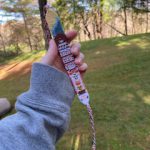
My completed chain is forty inches long. The next step is to add on the agate pendant on one end and the star and moon crystals on the other end.After the pendants are attached I added the bigger circular yellow crystals. These are placed at both ends to help accent the pendants.

The Orange Story: A Novella

Monday, July 26, 2010

CHAPTER FOUR

My first day of high school, I’m standing on the porch at seven-thirty, and my neck itches. There’s still dew out drying, but it’s already bright as hell. The sun’s like, Dude, get ready for a hot one.

The garage door motors open, and Dad backs out in his Sierra. He rolls the window down. “You miss the bus?”

I say, “No.”

“You want a ride?”

“No, thanks.”

“Suit yourself.”

He leaves, and I’m alone. What kind of trouble would it be to play hooky on the first day? Not worth testing it, I suppose. I keep scratching around my collar until I realize there’s a price tag hanging there. Jesus Christ, I almost started high school with a K-Mart tag flopping around on my back.

The bus shows up with ten minutes left before the bell. It’s a new bus. There’s no nose on the thing—the windshield just swoops down to nowhere, and all the windows are tinted black and twice as big as bus windows should be. The driver opens up the door shouting at me, “Get your butt in gear, honey!” She’s rolling again before she shuts the door. I have to hobble my way to a seat.

There’s only two other kids on the bus: some older guy I don’t know and a tiny girl from the grade above me with waist-length, frizzy hair she apparently decided should be platinum blond to start the year out right. I take a seat behind the blonde and scrunch myself low. The new vinyl smells like gasoline, and the girl’s hair like ammonia. Overhead, little speakers drone a Celine Dion song that at first I think is strange to hear on the radio these days but then realize, to my horror, is actually off a CD.

* * *

Well, well, welcome to Oakview High School. My homeroom class is Social Studies, definitely not gym, but my teacher, Mr. Durrel wears gym shorts anyway. He’s got a comb-over like you wouldn’t believe, and the end of his nose is a patchy-red bulb like my drunk Uncle Rick’s nose always is. I hand him the tardy slip the bus driver gave me.

“Mr. Baker?” he says. He throws the slip away.

“Yes.”

“You’re half an hour late. That’s an absence.”

I say, “The bus was late.”

“Not this late.”

“You didn’t even read the slip.”

“Just take a seat.”

I say, “Just read the slip.”

He yanks me by the collar to the hallway. “Are we going to have a problem?” he says.

“I’m sorry,” I say. “I didn’t mean anything by it.”

“Good.”

I don’t know where it comes from, but suddenly I’m up to my elbows in nerve. “I mean, no one told me you couldn’t read,” I say. “Next time, I’ll read the note aloud. The other kids won’t catch on. They’re pretty dumb. Your secret’s safe.”

He gets a look like he could hit me. But he just pushes me to the vice principal’s office—literally, he pushes me there like a piece of furniture—and throws me in, saying, “You deal with him!”

I get a look from a secretary like, Already? She picks up her phone and puts in the page.

* * *

I call my dad for a ride home after detention, and he almost buys my story about staying late to tutor a kid. He figures things out when I rush in the house to hit delete on the answering machine. He squeezes the story out of me.

He says, “You couldn’t even make it one damned day without mouthing off?”

I don’t know what to say to that. He wouldn’t understand, no matter how I explained it.

“Get your ass to your bedroom,” he says. “I don’t want to see your face before morning.”

I smuggle a cordless phone in with me, lock my door, and hunker down in my closet. I’m not crying, I’m just angry. I punch Mom’s numbers like the phone deserves a beating.

“What should I do?” I say.

“Ignore him,” Mom says. “Your father doesn’t understand what it’s like being smarter than the people around him. He’s a very simple man.”

“I mean about my teacher.”

She sighs. “That’s a tougher one. Just play it by ear, I guess.”

“You’re not being very helpful.”

“Well, he’s got you in a tight spot,” she says. “The man is an idiot, clearly, but he’s got all the power in this situation. You’re just going to have to choose your battles carefully. Hang low and avoid eye contact.”

I snort. “Can’t I just poison his coffee?”

“That’s more difficult to pull off than you’d think.”

“I wasn’t being serious.”

There’s a click like Dad’s picked up another phone. I hang up without saying goodbye.

* * *

I get the sense of things really quick: being a freshman is like one of those jokes that goes on forever, and when it ends there’s no punch line, you just laugh because the damned thing’s finally over. I guess I find my stride in a couple of days. High school is just a matter of coasting along.

I’ve got this one teacher—she’s all right. Miss Hyatt is the biology teacher for the honors-track kids. Her room is full of leafy plants she’s always spraying with oil to keep them shiny, and she’s got a pair of pet rats in a glass tank in front of the blackboard. Most of the kids don’t like her, especially the asshole guys in the back who only act tough when they’re surrounded by other geeks. Before the bell, while Miss Hyatt is poking around the equipment closet, they go on about her. “She’s kind of a twat,” they say. “Homework on the first day—total twat.”

“At least she’s smart,” I say. “That’s better than half the teachers in this school.”

“At least she’s got big boobs,” they say.

They are big. They’re like watermelons. I say, “They probably give her back problems.”

The guys just give me funny eyes. “What are you, Baker, a fag?”

Assholes.

Miss Hyatt starts her lesson. She throws up an overhead projection of some pea plants and starts talking about a priest named Gregor Mendel. Two pea plants with purple flowers, she says, will sometimes breed plants with white flowers—but not the other way around. She goes on about genes all hour. It’s really sort of interesting. This Mendel guy, he worked his whole life on that gene theory, and wouldn’t you know, nobody cared until after he died. I guess that’s how it is sometimes.

After class, I ask Miss Hyatt if she’s got a minute to talk.

She says, “Sure—” She leaves her mouth open like she’s trying to remember my name.

“It’s Derek.”

“Sorry,” she says. “First week foibles.”

I can’t tell for sure how old Miss Hyatt is. She seems pretty young—maybe thirty. She wears her hair back in a pony tail and a pair of square, black glasses. It’s not until I see her up close for the first time that I realize she’s part Asian or something. I guess the glasses are so thick, it’s hard to tell from far away—although, maybe that’s not the kind of thing you’re supposed to think out loud.

“I was just wondering,” I say. “I mean, just out of curiosity, if your mom has brown eyes and your dad has brown eyes and you have blue eyes, is that really possible?”

She turns her nose down, looking up over her glasses at my irises. “Well,” she says, “blue eyes are recessive, so it’s entirely possible. Sorry, bud, you’re not adopted.”

“Oh,” I say. “No, I was just wondering.”

She ruffles my hair. I think she can tell, I’m a little let down. “Actually,” she says, “eye color is a polygenetic trait. Very complex, so, not the greatest paternity test. There’s still hope.”

I nod along, real slow.

“Genetics,” she says, “they’re a wild beast. Very complex. And yet, when everything comes together, it’s like clockwork.” She holds up one of her hands in front of me to see. “For example,” she says, “I’m a woman, so my pointer finger is longer than the ring finger, see?” I see. She’s right.

She takes one of my own hands. “But you’re a boy, so, your pointer finger—”

I’m looking down at my hand, too. The pointer is clearly longer than the ring finger, just like hers is.

“Oh gosh,” she says. Suddenly, she’s blushing and anxious. “Well, you know,” she says. “It’s a complex beast. Like I said. Very complex.”

I’m not sure I like the way she’s acting. “I better go,” I say. “I don’t want to miss the bus.”

“Right,” she says. She’s got her head down like she just saw me naked or something. I run out the door without remembering to grab my notebook from my desk. I decide against going back for it. It’ll be there in the morning.

* * *

I’m not a guy who’s got a lot of friends. That used to bug me. In middle school, I wandered the lunch room like a lost puppy looking for a home. Every couple of weeks, I’d try squeezing in with some new group. Sometimes it was fun for a little while, but it was never very long before I found myself wandering again. It’s not like they kicked me out of their groups—I mean, sometimes they did—but usually it was more like we just mutually realized we had nothing in common, and I drifted away, off to look for some new group of kids to join.

I almost got in with the theater kids. That was the closest I came to making real friends. They were a nice combination of smarts and mischief-making, like they were all just on a different plane of reality that was fun to visit. But that only lasted a few weeks.

I blew it with the theater kids by being too much of a dweeb. One day—I think it was about a month after we started hanging out—we were loitering after school by the dumpsters in the parking lot, and a girl pulled out a pack of cigarettes she stole from her mom. They all started smoking like they were old regulars at it. And I could have just said no when they offered, but instead I said no and then lectured the whole group on what a bunch of idiots they were being and how they may as well just crawl into their coffins and get it over with. They looked at me like I was just the worst kind of traitor.

It was so awkward, I just slunk away. None of them ever talked to me again. When I told my mom about what happened, she said, “Derek, sometimes it’s all right to let loose for awhile.” I thought she’d have told me I did the right thing.

These days, I mainly keep to myself at school. There’s this group I sit with at lunch, but it’s not like we’re sitting together—we’re just all the kids with no friends, so we sit there and eat and don’t say a whole lot. There’s a band nerd who somehow got banished by the other band nerds, and there’s this girl from my honors classes who’s obsessed with getting A’s because it gives her something to obsess about other than her lousy drunken parents.

I know it’s strange, but you could almost say my best friend at school is Miss Hyatt. The day after she gets all awkward on me, she asks me to stay after class and talk. She says she’s sorry about the other day, and she was really just out of sorts because of the start of the new school year. Then she asks me if I’m really interested in Biology. “It’s hard finding kids who care,” she says.

I tell her, sure, I like her class better than my others, so she asks if I’d like to stay after school with her sometimes. “I could use a hand,” she says. “Lots of test tubes to clean.” Then she tells me that sometimes she has ideas she’d like to test out but that she needs a lab helper. She’s contemplating a study on amoebas, and she could use some help recording the data. If the results are interesting, she says, we might even publish the findings in a science journal.

I say, “I thought you needed degrees and white coats for that kind of thing.”

She says, “Heavens no. People make major discoveries out of garages.”

I guess that’s pretty cool. “Sure,” I say. “Let’s do it.”

So now I’ve got an extracurricular. Imagine that. Dad actually gets pretty pleased about it—once I manage to convince him this is a real thing and not just some kind of cover-up for detention.

I start meeting with Miss Hyatt after school on Tuesdays and Thursdays. I wash microscope slides and mix batches of lab chemicals for the older kids in AP Bio. Sometimes she has me sit with her by the microscope and jot things down. Mostly, I tend to the rats. Despite being females, their names are Darwin and DaVinci, and they go through an awful lot of wood shavings. Mostly, it’s boring stuff, but it’s something to do, and it gives me an excuse to make Dad pick me up after school twice a week instead of having to ride that awful bus home. I mean, seriously, whoever came up with the idea of putting CD players on school busses should have realized that bus drivers have the most god-awful taste in music in the world. I’d much rather sweep up rat poop.

End of Serial Number Four.  Chapter Five will be coming on August 2nd.

Previous Chapters
Chapter One
Chapter Two
Chapter Three

Next Chapter

Ryan K. Jory was raised in a suburb of Flint, Michigan, where he began
writing at the age of nine. The Orange Story, written while a master’s
student at Miami University of Ohio, is an adaptation of his Hopwood
Award-wining short story, “The Messenger Orange.”

The Process: Kristen Glonek Part 4

Sunday, July 25, 2010

From the top of this column it should almost look triangular. The next step is to pass an open ring through two adjacent rings at the top. Pass an open ring through two more adjacent rings in the top cage. Make sure it doesn’t go through the ring you added. Pass an open ring through the remaining two rings. Again, make sure this ring doesn’t go through either of the rings you added. This completes the next cage. Now all that there is left to do is continue with this last step until the chain is the desired length. For this type of necklace it depends on how far down you would like each side to hang but I recommend making the chain at least twenty inches long at the bare minimum.

The Orange Story: A Novella

Monday, July 19, 2010

CHAPTER THREE

August takes forever to arrive. When it does, I can hardly keep from jumping around. I finally get to see Mom again. Finally! I pack a bag with all the shorts I own like I’m never coming back. On top of the pile, just for kicks, I stick my Orange book.

Normally, I sleep great on planes, but this time I’m too excited. The woman beside me is very nice. She’s maybe in her fifties. She says she’s been visiting a sister in Lansing and she’s glad to be getting back. “What about you,” she says. “Just starting your trip or going home?”

I say, “Both.”

The airport in Tampa is like a spider—you get off your plane on one of the legs and take a tram to the belly where your ride waits for you, tapping her foot like it’s your own fault the flight was delayed.

Mom doesn’t look good. She’s in this wrinkled, red Coca-Cola t-shirt like she got dressed out of a lost-and-found box. And her hug doesn’t feel right—too weak. “You okay?” I say.

“I’m fine,” she says. “Just tired.”

“I missed you.”

She nods with a puny smile.

Mom’s home, for now, is a sublet apartment in a building that’s almost completely vacant. They’ll tear it down soon, she says, to put up a set of condos. “It’s a hellhole,” she says. “But they’re renting by the month until the wreckers come, and it’s cheap.”

The apartment is only almost as bad as she describes it on the way. The carpet is brown and worn nearly through to the floorboards. The walls are painted cinderblocks. The furniture looks like most of it came off a curb or from a dump. But my room has a sliding glass door and a balcony, and though the blinds are broke and won’t open, Mom pushes them aside so we can step out.

“It’s nice,” I say.

“You don’t have to humor me.”

“I mean the view.” We’ve got a sixth-floor perch just a couple blocks from the bay. You can see to the water between the high rises, over the tops of buildings below. It’s so beautiful, like wavy black glass.

“Have a seat,” Mom says. There’s a white metal table on the balcony, the kind you see outside of cafés, with two almost-matching chairs beside it. She takes the one with flaking paint.

We chit-chat for awhile. It’s like when we’re on the phone, really—only with a view of the sun setting down on Tampa Bay instead of the dirty clothes heap in my closet.

“Have you seen John lately?” I say.

“Not lately.”

“I like him. I think you should marry him.” I’m only partly serious.

She holds back whatever she’s thinking, but it’s clear she’s just melting inside. “I haven’t got much in the fridge,” she says. “We’ll have to order out.”

She gets some menus from a drawer in the kitchen and says I simply must try something new, preferably spicy. We decide on empanadas. “They’re Cuban-style around here,” she says. “Like a calzone, only fried, so they’re better.” I can hardly argue with that.

She pays the delivery boy with a wad of ones. “Would you like a glass of wine?” she says.

I look at her like this is some kind of a test.

“Just a glass,” she says. She holds a hand over her heart. “I promise it’s not going to kill you.”

So I nod.

We eat on the balcony with two tea candles for light. The smells coming in off the street are a nice mix of city fumes and sea salt. “This is wonderful,” I say.

“The wine?”

“No,” I say. “Just everything. Just all of it is nice.”

* * *

I’ll be glad when Mom gets her life better settled. She can’t take many days off work and still make the rent, so I spend half my time in Tampa watching fuzzy TV over-the-air on a set in her bedroom while she’s off pouring beers at some bar below. I ask if she’ll take me to see the place. “No,” she says. She assures me it isn’t a Hooters—just a place that might as well be.

The only food Mom has in the cupboards is value-brand tuna and dozens of cans of mushroom soup. The soup, she says, was an unbelievable bargain. I don’t know what that means, and I don’t trust it.

I sleep on a very stiff twin bed that’s got a plastic sheet beneath the covers. “That’s to protect you from the mattress,” Mom tells me. “Not the other way around.”

Not a lot else happens this visit. It’s not like the first time down. Mom gives me quarters one morning for an arcade down the street. “It’s going to be a long one,” she says. “I’m pulling a double shift.” I take the quarters to the laundromat across the street instead of to the arcade, along with all the clothes from her hamper. I figure she’ll appreciate the gesture. Also, I could stand to wash a few pairs of socks.

While I’m pulling the clothes out of the dryer, I happen on a black pair of men’s bikini briefs. At first, I just freeze up, like what am I supposed to do?

I’ll just put them back in the hamper is all. I’ll stick the whole load back in there, and she’ll never know the difference—unless she happens to notice that her dirties smell clean. Oh God! Why did I have to pay extra for the softener with the mountain scent?

A tiny, quiet woman two machines over catches me with my nose in the underpants and gets a crooked look.
“It’s not what it looks like!” I say, and I throw the damned things back in my basket. I’m out the door so fast, I lose a sock along the way, and I’m sure as hell not going back to pick it up.

* * *

Our last night together, we order Indian food. Mom has a spot of curry on her chin. I reach over to wipe it with my napkin. “Since when are you so keen on spicy things?” I say.

“Forever,” she says. “Did I dribble?”

“I got it.”

“Thanks.”

I try not to act like I’m let down by the fact we’re spending our last night together the same way we did the other twenty. I guess it shows, though.

“Are you feeling okay?” she says.

I shrug. “I just can’t believe it’s been three weeks already.”

“I know,” she says. “I’m sorry.”

“For what?”

“Next time you come, I’ll plan something fun. This hasn’t been much of a vacation.”

“I don’t want it to feel like a vacation,” I say. “I just want it to feel like home.”

She looks around the balcony like, Not in this dump. “It’ll get better,” she says. “Once things settle in. Next time, it won’t be like this.”

She’s still got the spot of curry on her chin. I just haven’t got the heart to tell her.

“Let’s play a little game,” Mom says. “Truth or dare.”

“That’s ridiculous.”

“Okay,” she says. “Dare.”

“I dare you to spit off the balcony.”

She looks at me like, That’s all?

“Not just a little one,” I say. “A big snotty one. And you have to wait until there’s someone on the sidewalk below.”

“No problem,” she says. She stands and leans over the balcony, holding tight to the rail with one of her legs kicked back behind her. There’s a bag lady coming.

“Don’t do it to her,” I say. “Wait for someone else.”

Eventually, there are some guys coming down the street like they’re on the way to a party. They’re acting a little too happy to be sober, and judging by the football jerseys they’re wearing, I’m guessing they’re some kind of jerks.

“Perfect,” she says. I agree, and she lets loose an incredible loogie. It slaps against the concrete about two feet away from the guys. They’re startled, and they all look up at us like, What the hell?

“Sorry!” Mom says. “Had to—it was a dare.”

“You’re a crazy bitch, lady!”

“That’s for sure,” she says, and we sit back down.

“Okay,” I say. “Truth.”

“Hmm,” she says. “If you could date any woman in the world, who would it be?”

“Oh, geeze.” I hate these kinds of questions.

“Come on, you have to tell me. It’s the law.”

I pretty much throw out a name at random. “I don’t know… Hillary Swank.”

“Really?” She gets puzzled. “She’s so boyish.”

“Well, I don’t know.”

“Hey,” she says. She throws her hands up. “I’m not here to judge.”

I say, “Your turn.”

“Truth.”

I think for a second. “How about… Have you really tried drugs before?”

She starts laughing so hard, she nearly falls out of her seat.

“Really?” I say. “Which ones?”

She keeps snickering. “Oh, Lord. It would be faster to name the ones I haven’t tried.”

For the record, she has never tried crack cocaine or heroin. I guess you learn something new every day.

End of Serial Number Three. Chapter Four is coming on July 26th.

Previous Chapters:
Chapter One
Chapter Two

Next Chapter

Ryan K. Jory was raised in a suburb of Flint, Michigan, where he began
writing at the age of nine. The Orange Story, written while a master’s
student at Miami University of Ohio, is an adaptation of his Hopwood
Award-wining short story, “The Messenger Orange.”

Current Print Issue

Straylight 4.1 is complete! Contents overview available at the Current Print Issue Page.